
Having worked in leadership positions, run my own business, I have valued being both pragmatic and empirical in my decision-making.
But what I observed with many of the leaders of the customers I worked with is their reliance on frameworks, rituals, tools, and habits.
I saw leaders
Jump to solutions without understanding the problem
Unsure of how to solve complex problems
Rigid and stubborn to change, even though all evidence pointed it’s not working
Fear of failure if they made the wrong decision
Avoiding dealing with issues
Not taking ownership of the situation
The problems they faced were never addressed; they lingered and held back their teams, increasing the cost of delay and, worse, making their positions harder.
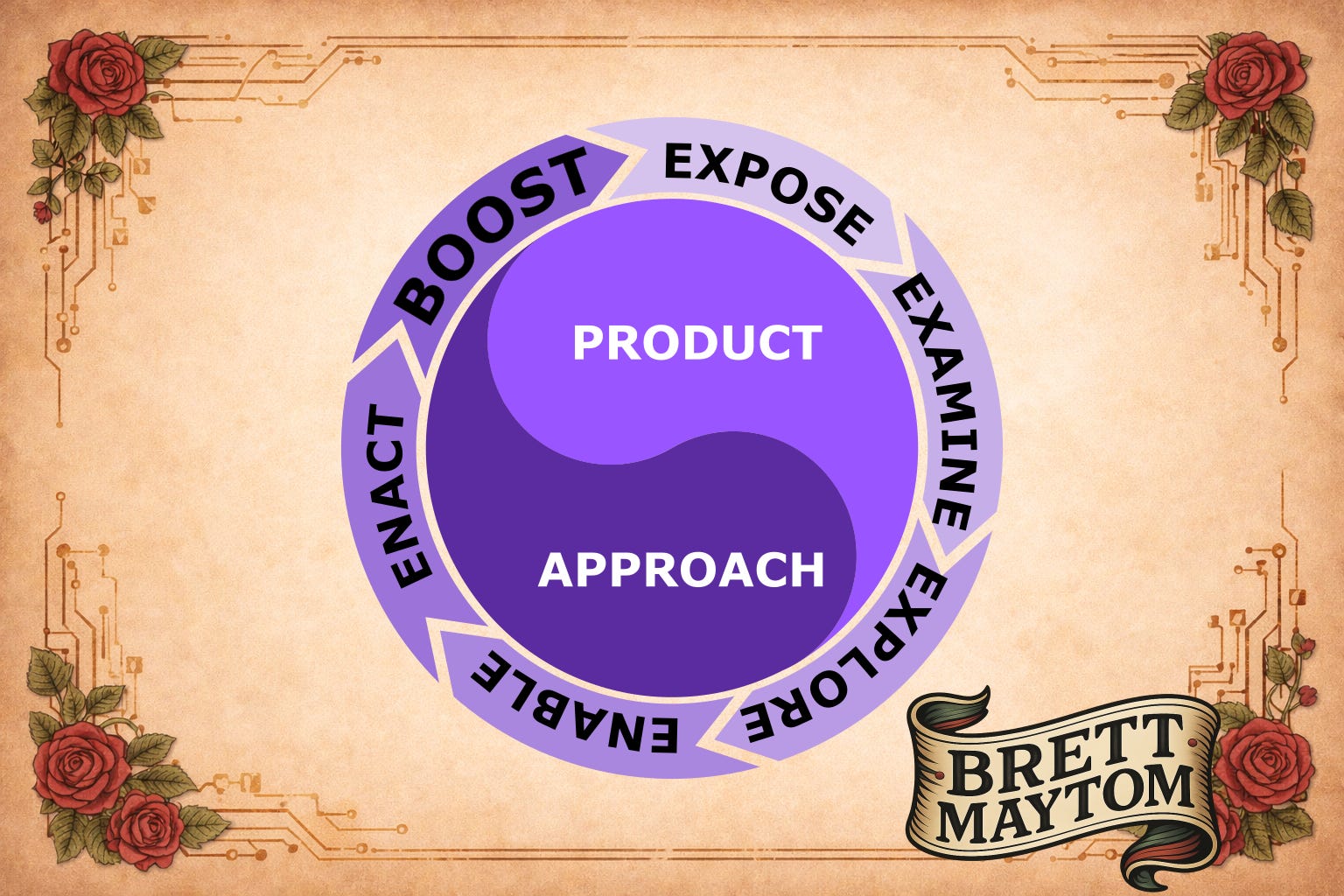
That’s why Practiqual® is built around a clear, grounded cycle —
BEE: Expose, Examine, Explore, Enable, Enact, Boost.
It may sound light, but it isn’t. BEE is the thinking engine of Practiqual.
Not a ritual. Not a diagram. A decision-making muscle for a complex environment.
Why BEE Exists
Because in technology and in many other industries, people are hardwired to rush from challenge to solution.
The solution starts before the problem is understood.
The change is launched before the cause is clear.
The system is changed before it is seen.
BEE says: Slow down and THINK before you act.
Not to waste time, but to use it smarter.
It gives leaders and teams the space to:
Think clearly
See the system
Explore smart options
And actually lead the change they’re trying to make
It’s slowification with purpose. A pause between trigger and response.
That’s where strategy lives.
The Six Steps of BEE
1. Expose: Say the quiet part out loud
Stop glossing over what’s broken. Expose is where truth is surfaced safely, clearly, and without the usual defensiveness.
No judgement. Just facts, patterns, tension
If you can’t see it, you can’t shift it.
This is where early systems thinking begins. It is not just about surfacing symptoms, but recognising patterns that might point to deeper structures.
If you're not going to talk openly and transparently about challenges, they will not magically disappear.
Reveal it! So you can deal with it!
2. Examine: Understand what’s really going on
Now you go deeper. This is where systems thinking becomes essential.
Examine means looking beyond the visible to uncover the loops, incentives, contradictions, and constraints that hold things in place.
Gather facts and data. Stop the madness of decision-making on pure opinion, especially the H.I.P.P.O. (Highest Paid Persons' Opinion).
You start asking questions like:
What is driving this behaviour?
Where are the feedback loops?
What assumptions are still in play?
What is the impact?
What is the root cause?
This is where “fix it” becomes “understand it”. Your goal is to really understand the challenge. Get the facts. Get the data. Get the real picture. Use this to make better-informed decisions.
3. Explore: Think through the smart options
Now, and only now, you think about possible solutions.
Explore is structured creativity. It is informed by what you have exposed and examined, and guided by systems thinking to avoid short-sighted fixes.
It asks:
What could shift the system in useful ways?
What are the trade-offs?
What is best to try, safe to test, and meaningful to learn from?
You are not hunting for perfection. Just the next best move.
Brainstorm ideas, even if the idea is “suck it up and live with it”. Just don’t jump at the first solution that pops into everyone’s head.
Look at the pros and cons of each.
Then make an informed choice. Choose one!
4. Enable: Set the change up to succeed
This is leadership territory. Not just permission, but preparation.
Enable means communicating clearly, getting alignment, removing blockers, and creating the conditions where change can land and last.
It also means anticipating how the system might push back and working proactively to reduce that resistance.
Too many leaders announce a change and walk away
Enable is how you make sure it does not die on impact.
This is change management 101.
5. Enact: Make the move
Enact is where intent becomes real. You do the thing
Visibly. Accountably. With a full understanding of the context behind it.
You are not just delivering change. You are intervening in a system with clarity about consequences and interdependencies.
The change is no longer an idea
It becomes part of how we operate.
6. Boost: Make it stick or move on
This is where momentum comes from.
Boost is where you learn out loud:
What worked? What did not work?
Why?
What could have been done better?
Who else needs this insight?
How do we embed or scale it?
Boost reinforces beneficial patterns and shifts systemic behaviours. This is not just about writing up “lessons learned.”
No more “that was last sprint’s win, we’ve moved on”
Boost makes sure improvement does not evaporate.
Boost is re-entering the BEE cycle to amplify the learnings. It’s there to raise the bar higher and better. It is the relentless pursuit of continuous improvement.
Comparison: BEE, OODA, PDCA and Scrum
Many established models support feedback and adaptation. These include OODA, PDCA, and Scrum. Each has influenced how organisations respond to change. Each has strengths.
However, BEE was developed to address a recurring pattern: the move from problem to solution is often rushed, shallow, or overly focused on teams alone. In contrast, BEE provides a deliberate reasoning model that places equal emphasis on systems thinking, organisational resistance, leadership enablement, and reinforcement of success.
Here is how BEE compares:
OODA (Observe, Orient, Decide, Act) is a decision-making loop designed for rapid response in dynamic or adversarial environments. It supports fast thinking, tactical shifts, and continual adjustment in response to new information. BEE shares the goal of informed action but takes a more deliberate approach. Where OODA focuses on speed and muscle memory to specific situations, BEE introduces structured reflection through Expose and Examine, and slows decision-making when complexity or collaboration requires it. OODA does not address how options are explored, how change is enabled, or how improvements are embedded. BEE includes Explore, Enable, and Boost to provide those capabilities, making it better suited to organisational change that requires shared reasoning and sustained follow-through. OODA has its place and is especially effective in chaotic environments.
PDCA (Plan, Do, Check, Act) is a structured loop for continuous improvement and process optimisation. It is effective in stable systems where processes are known and improvements are incremental. BEE overlaps with PDCA in its focus on deliberate action and learning, but provides more structure in situations of uncertainty. PDCA does not include explicit steps for exposing hidden issues, exploring multiple options, or preparing the organisation for change. BEE adds Expose, Explore, and Enable to deal with ambiguity, and Boost to reinforce progress across the system. This makes BEE better suited for complex or adaptive environments where linear plans are insufficient.
Scrum is based on empirical process control, which is defined by three pillars: transparency, inspection, and adaptation. These are essential mechanisms for managing complexity and enabling iterative improvement. BEE aligns directly with these pillars through Expose (transparency), Examine (inspection), and Enact (adaptation). However, Scrum provides no formal mechanisms for exploring options before acting, enabling the system to support change, embed, and amplify success. BEE fills these gaps through Explore, Enable, and Boost. This ensures that the three pillars of empirical control are not just present, but deeply supported and sustained across the organisation.
BEE is not a delivery method. It is a structured thinking model that enhances decision-making, change preparation, and progress integration. BEE is not competing with OODA or PDCA; they have their place and benefits. Context matters. Scrum, on the other hand, I feel, is misunderstood, and most people treat transparency, inspection, and adaptation as mechanical actions.
BEE Is the Missing Layer
You do not need another framework. You need a better way to think.
Most teams are already building, reacting, and adapting. But that alone is not enough.
Without slowing down to understand, prepare, and reinforce, most changes are short-lived.
BEE fills that gap. It brings structure to clarity, leadership to action, and durability to learning.
And in Practiqual®:
BEE is not just how we think. It is how we lead.